Vanessa Lawrence on “Sheer”, the Intimacy of Makeup, and Intergenerational Power Dynamics
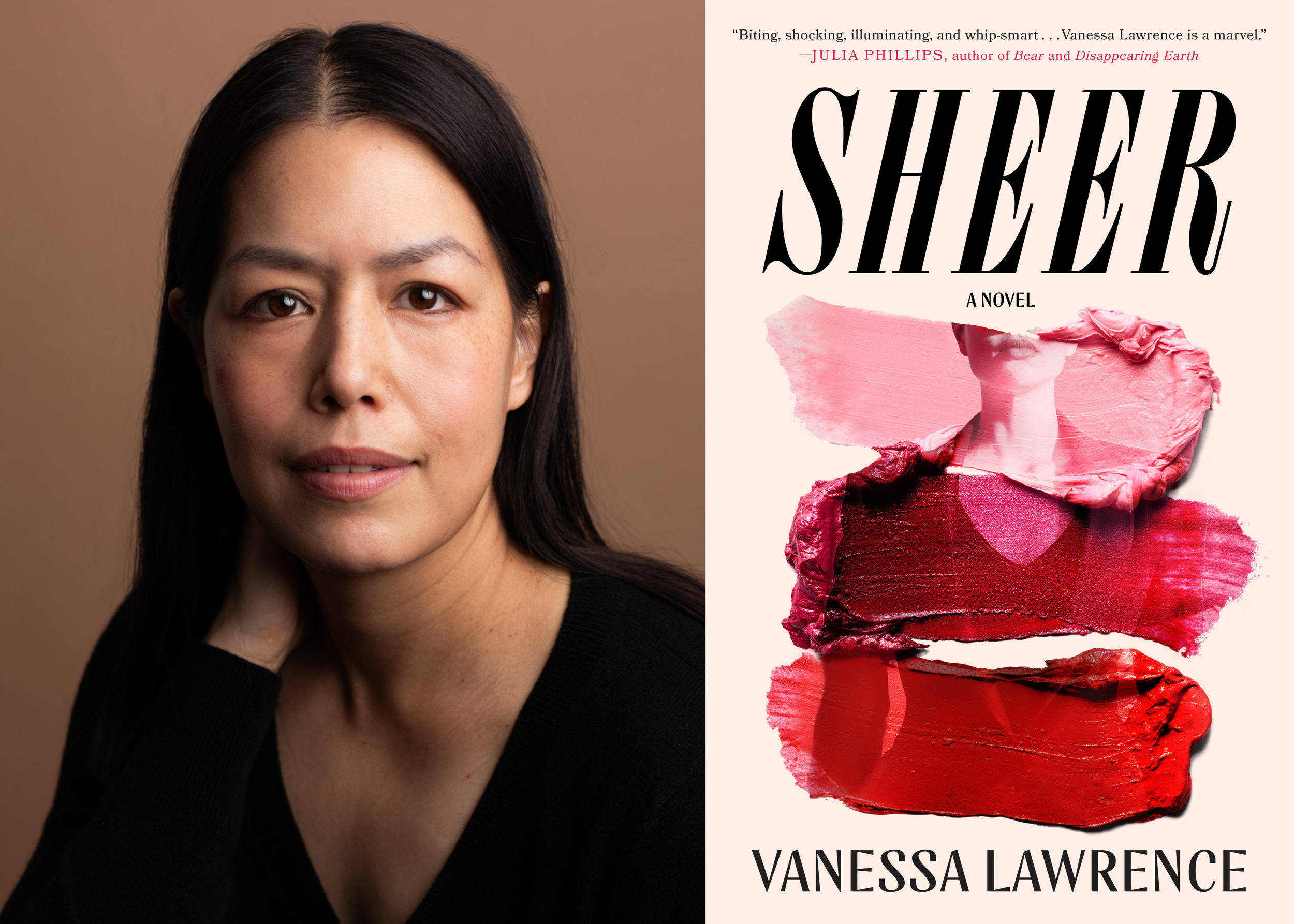
Photograph of Vanessa Lawrence by Frances F. Denny
Vanessa Lawrence’s novel, Sheer chronicles the life story of Maxine Thomas, the founder of a beauty company, Reveal, who is public about her love of makeup and making women feel beautiful while remaining secretive about her sexuality. Max’s story begins with her adolescent discovery of playing with makeup application – and realizing that she is attracted to girls. The story then leads up to the moment that Max is suspended from her own company due to a highly publicized personal and professional scandal. As she awaits the verdict of the hearing, Max writes down her own story, letting the reader in on everything that led up to the mistakes that will become Max’s downfall – which, without giving away too much, has to do with the younger woman who works as Max’s assistant, Amanda.
Max’s story is a gripping, fascinating tale that will make every reader – whether you’re a beauty enthusiast or not – care about the makeup industry, as well as, even more significantly, what it takes to make it as a female entrepreneur. Max’s voice is strong and vivid – it feels as though she is confiding in you, personally. You will root for her, but you will also question her as hints of her unreliability seep into the narrative – the events that play out may not be exactly as Max remembers them.
Lawrence explores the book’s themes – including, mainly, the ways in which power dynamics are nuanced and complex – with precision and intelligence, leaving you with a complicated examination on how the pressures of an industry can shape and challenge one person’s ideologies and actions. All that is to say, it’s an un-put-down-able book.
Below is my conversation with Vanessa Lawrence, in which we discuss the power dynamics at play, writing an unreliable narrator, and more.
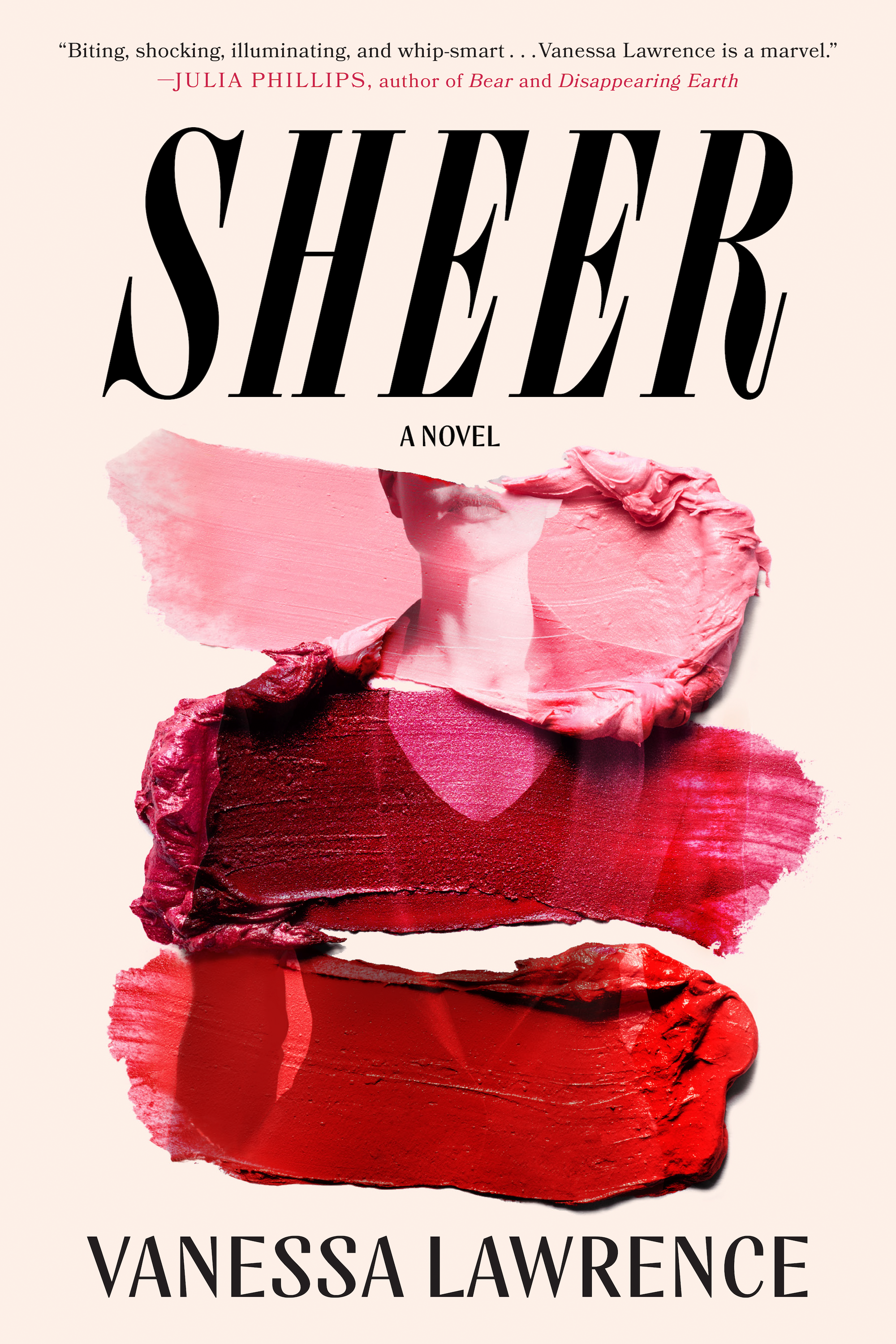
Nikki: How did you get the idea to write Sheer?
Vanessa: Well Sheer started with my debut novel Ellipses, actually. I was really interested in continuing to explore some of the themes that I had grappled with in Ellipses – things like professional womanhood, female agency, power dynamics between women of different generations, particularly when it overlaps with the workplace – but from a very different perspective. Ellipses is written in the third person and it’s from the POV of an early thirties journalist and I wanted to see things from an older, middle aged woman’s perspective and that brought me to Max.
Nikki: Then, how about the general premise? How did that come about?
Vanessa: Well, again, playing off of Ellipses, I started with this idea of a relationship between two women of different generations, separated by a good number of years. But, interestingly, the relationship between Max and Amanda – which was, for me, the starting point of Sheer – takes up less space in the overall book than I had originally imagined it would. I just really became so interested in the full span of Max’s life and in the idea of this woman who, because of the present circumstances, is being forced to, for the first time, access her own narrative. That idea was really compelling to me and that drove me through a lot of the first draft.
Nikki: I think that really shines through, her life story is so compelling. What was the research process like? I know you have a history as a journalist and have reported on beauty before. Where did you go from there?
Vanessa: It started with a combination of personal and professional. So personally, I came of age as a teenager in the 90s and I was always interested in beauty as a teenager reading magazines like Allure and seeing all of the different indie brands coming out at that time. Max starts her company, Reveal, in the late 90s and so some of my memories of that era, just on a personal front, helped inform a little bit of that world building. Then professionally, I worked in fashion media for a long time. I was never a beauty reporter specifically, I was more of a generalist, which I loved [because] I was very fortunate to be able to cover so many topics. But I did write about beauty at different points in my career and that gave me a really great, more macro view on the industry, on how brands build themselves, and the storytelling aspect around building a brand. And then, working on Sheer, I just read as many interviews as I could with different beauty founders. Marisa Meltzer’s Glossy [about Glossier founder Emily Weiss] came out fortuitously while I was revising Sheer and that’s such a great book. It’s so well written, well reported, well researched. It was really exciting to have that non-fiction account of beauty as insight. And I also went to different beauty retailers and would just play with the products and enjoy eavesdropping on and observing other people around me to see what they were interested in and what they reacted to. But ultimately, with a novel, at least for me and how I wanted to approach Sheer, you do all this research but it’s the narrative and Max’s character and her desires that really have to drive the story. So my goal was to make the story as believable and rich and detailed as possible but without letting the research take over things.
Nikki: I love how detailed the makeup scenes are – the scenes of Max doing makeup were so immersive. I’m wondering how you came up with these detailed scenes? What was that process?
Vanessa: Yeah, you know, I am not personally very talented with makeup brushes, so it was definitely convenient for my character to prefer a more hands-on approach, like literally speaking, as opposed to a more precise, brush-oriented approach. But what I really was trying to capture with those scenes, which I hope came through, is the sense of intimacy in makeup – in makeup application and wearing makeup. It’s such a tactile medium. Whether you’re putting it on yourself or you’re playing with a friend and you’re doing each other’s makeup, you’re touching your face and you’re touching other people’s faces. And that is such an intimate thing to do. You rarely do that in other contexts in life. And I hoped to capture that closeness and proximity and tactile element of beauty and how that inspires Max and how that fulfills her.
Nikki: I wanted to talk about the relationship between Max and Ellen [her financier who acts as a mentor and mother figure in Max’s life], which I found to be one of the most fascinating – and often infuriating – elements of the book. How did you settle on the specifics of their dynamic? For example, how did you decide how far Ellen would go in betraying or controlling Max?
Vanessa: Thank you for asking about Ellen because that is such an important relationship in this book. It’s interesting because Max and Amanda, that was the starting point for Sheer, and I didn’t plan on an Ellen character. I free write my first drafts usually, I don’t outline, and so that character emerged in the drafting process and I was so happy that she did. It felt like it gave me this opportunity to show Max as both the younger woman to an older, powerful woman and then, later in her life, as the older, powerful woman to a younger woman. I loved the idea of having this continuum of power dynamics across three generations of women, that felt really exciting to me. With Ellen and Max specifically, as it is with Max in so many other relationships in this book, I really thought about the different kinds of power that they each have and how they use that power and what their different motivations are. Ellen has a lot of power over Max – financial power as her main investor, emotional power as a quasi maternal figure and mentor to her, social power because of the position she has in society, experience, the power of age. But Max has power in that relationship too – she has creative power as the real soul and vision behind Reveal. And she has certain power as a young woman in a society that tends to idolize female youth. And she has power from her sense of independence, [which] I think is something that Ellen envies in Max. That was really how I approached the relationship, thinking about what do they admire and envy in each other and how do they act on the different ideas of power that they have about the other person.
Nikki: What was it to write some of the most sexist, misogynistic encounters and situations that Max faces? Those parts could be excruciating to read.
Vanessa: It was very difficult. It’s challenging as a novelist because we often have to make our characters suffer in some way as part of the narrative. That part is never fun at all. And particularly because I was writing it in the first person voice of Max, that added another layer of challenge. Max has so much self possession and confidence as a character – and [she is] maybe even an intimating figure – but there are also moments in the book, like those moments, when she feels powerless, and I think those scenes were really important. I think that duality of confidence and powerlessness is quite key to Max in general and I hope [those scenes] help bring that to light for the reader.
Nikki: I loved the unreliable narrator aspect of it. It’s so easy to get caught up in Max’s perspective, but then seeing little hints that things are not how Max is portraying them, especially with Amanda, is so compelling. While you were writing Max’s side of things, did you also have Amanda's perspective in your head? Or how did you approach the unreliability overall?
Vanessa: Thank you for noticing that and for asking that because it was a real challenge of this novel, one of many challenges in writing this novel. I very much wanted to be true to Max’s POV and, the way that I believed Max would process the world and process that relationship [with Amanda]. I didn’t want to impose my own view of things onto Max or the novel, but at the same time, I did want to try to signal to the reader the exact element that you just described: the possibility of unreliability in her voice, the possibility of other perspectives that she is maybe not considering. And so, in order to do that, I did have to think about Amanda’s view of things and I did have to think outside of Max’s perspective. But for me, I had to strike this balance of not going so far outside of Max’s perspective, even as an author, that I could no longer reenter Max’s perspective in the writing of the novel. And so, it was a huge challenge. I also think different readers, at different points in the story, will potentially pick up on those nuances, depending on their own experiences of the world, their own backgrounds. And I wanted to leave room in that way for one reader to view a scene one way, another reader to maybe pick up on something else later, and so on.
Nikki: Did you always know what Max’s downfall was going to be?
Vanessa: I didn’t know how that was gonna play out at all when I first started drafting the novel. I just knew that something needed to happen that would force someone like Max, who has this very dominant world view – [she has] this very well-honed world view of like, this is who I am, this is how I got here, this has been my journey – to reassess this. Of course, you’re seeing in the book a reluctance on her part to reassess that or a reluctance to let self doubt in. Some of that is coming from a survival mode that she’s been in. Someone with all of the things she’s struggling with and someone in that position professionally at the head of a company with so much responsibility on her shoulders might potentially fear self doubt because if you let a little bit in, then maybe the whole thing falls apart. It was that instinct for me that [whatever happened] needed to really impact her in a significant way. Whatever needed to happen to cause that potential reassessment.
Nikki: In what ways do you view the world of makeup differently now? Has it changed how you shop for makeup or how you want to present yourself with makeup?
Vanessa: I think the biggest thing that has changed about my approach to makeup is less to do with the content of Sheer and more with the logistics of being an author and novelist. I spend so much time alone in a room with a computer, not interacting with other people – which I’m incredibly lucky that I get to do this but it’s a very different lifestyle than going to an office or having a job where you have colleagues that you are regularly interacting with. That has certainly had an impact on how frequently I wear makeup and the extent to which I even think about it. But writing this book helped me articulate something that I’ve always felt about beauty – meaning makeup, specifically – but never fully expressed to this extent: makeup is physically superficial, we put it on our skin and then we wash it off at night, but the impact of it is very layered and very resonant and very deep for many people, both the people wearing it and the people who observe it. The choices that we make about our self presentation, they can shift how we feel about ourselves but they can also shift how other people feel about us and how they feel about themselves. That was something that I really took away from working on this book – the tension in makeup between physical superficiality and emotional depth. That was part of what made writing this book such a joy.
Nikki: It’s so interesting to think about all of the different nuances of the world of makeup and what it means to wear it. I’m thinking about the scene where Max is annoyed at younger women wearing ‘too much’ makeup and Amanda says, ‘Well, they’re expressing themselves.’
Vanessa: Yeah, it can be so fun and so playful in its best iteration and it can feel punitive or exclusionary in its worst iteration. And sometimes both of those things coexist.
Nikki: What are some of the books you read while working on Sheer that helped the process?
Vanessa: There are a few books that come to mind that I read as I was working on Sheer that wre helpful or inspiring. Not really content wise, necessarily, but in the way that they approach fiction. Early in the process of drafting Sheer, I reread Remains of the Day by Kazuo Ishiguro, which I had read a long time before, and that was really beautiful – in part because of the way that he navigated time in that book, the way that past and present often coexisted for that character. Also, Biography of X [by Catherine Lacey] came out while I was revising Sheer and that’s such an enthralling and incredible book. The sort of art monster figure of that, [I thought] the way that she approached that figure was so exciting to see. I do think Max is a little bit of an art monster figure, too. Also, [Lacey’s] world building, the way that she transformed references or actual pieces of our culture in such imaginative ways, that was thrilling. Those are just a few of the books I read while working on Sheer that I found particularly enthralling.
This interview has been edited and condensed for clarity.

Nikki Munoz / Editor
Nikki Munoz is a writer living in Los Angeles. She has written for the LA Times, Looper, Stage Raw, and more. She received her MFA in Creative Writing from Antioch University in Los Angeles and is currently working on a novel.
Find her on Instagram @nikkimunozwrites
Read More