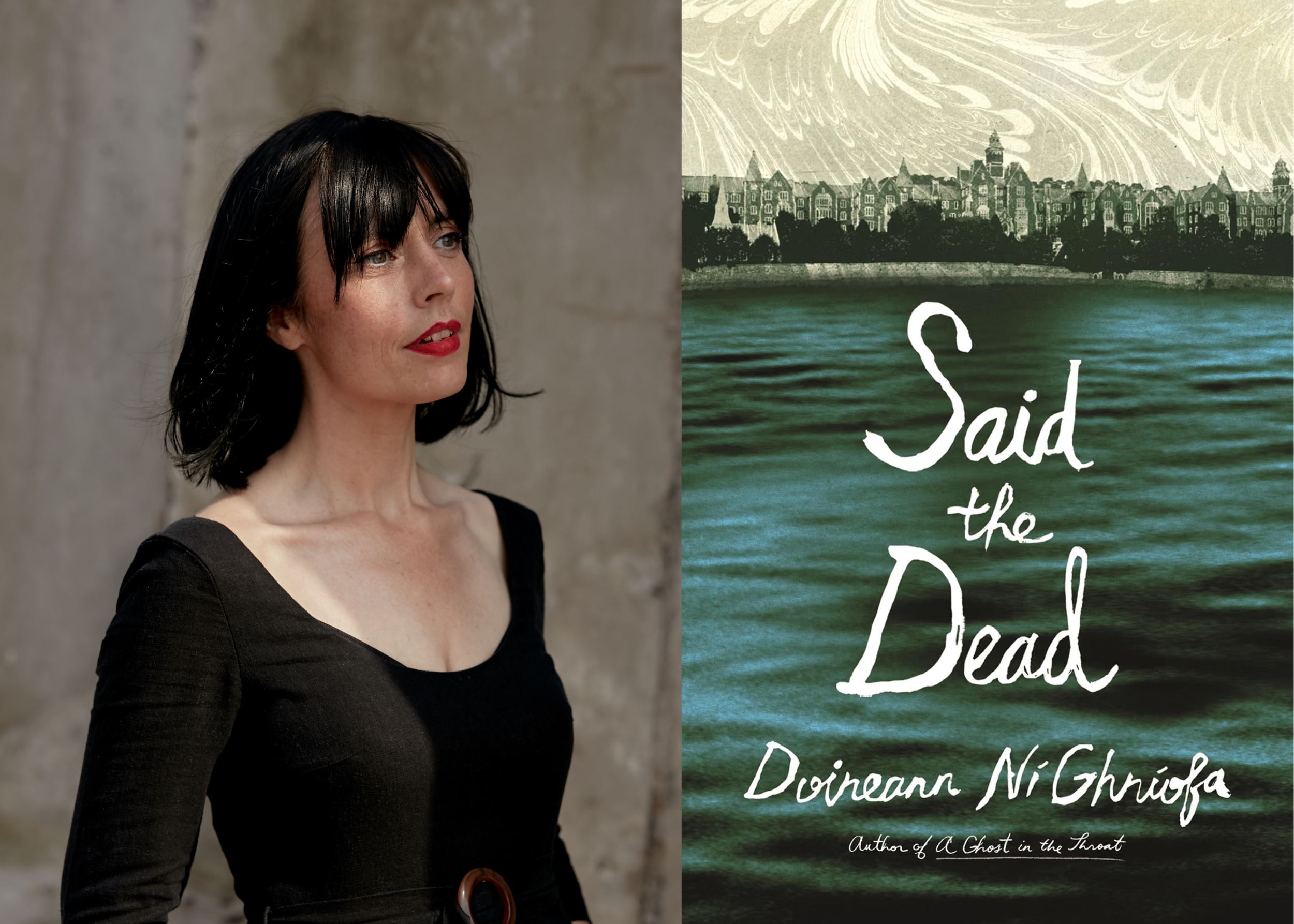
Doireann Ní Ghríofa on “Said the Dead,” the Erasure of Women from Historical Records, and Whether Ghosts Are Real
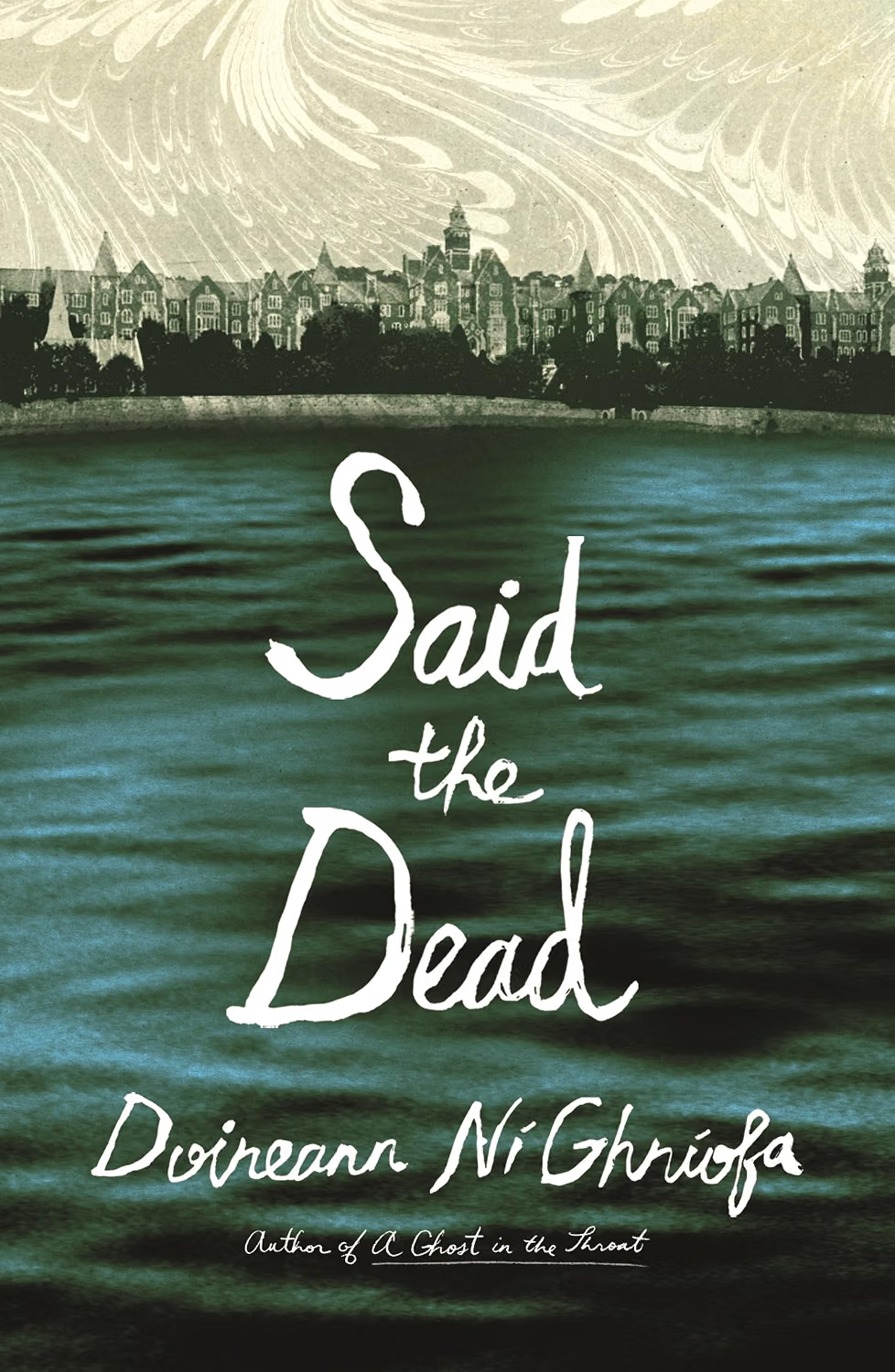
Doireann Ní Ghríofa, in a silk sapphire shirt against a sapphire curtain, gazed off camera as if she was seeing an apparition. It is this otherworldliness that characterizes her latest book, Said the Dead. The book is about a dilapidated mental hospital in Cork and the many women—past and present—who wandered its hallways. It is a follow up to her memoir, A Ghost in the Throat, in which Ní Ghríofa links two stories: the historical account of an 18th century poet and her own complex experience of motherhood.
Part history, part autobiography, part speculative fiction, Said the Dead delves into the Cork City and County Archives to uncover dormant stories. Ní Ghríofa, who told me she “exclusively writes weird books,” mixes media – she blends prose, poetry, photographs, and historical documents. The book centers on Lucia Strangeman, a doctor at the mental hospital in the early 1900s. Through Lucia’s eyes, as well as the present-day Reader who fixates on researching the asylum, we are introduced to a chorus of hospital patients. Their voices form a bewitching song.
Braiding two timelines, past and present, Said the Dead explores how women have been punished for emoting and what we can learn from our obsessions. It rotates around a central question: what do we do with our grief?
I spoke with Doireann about writing from multiple POVs, distilling piles of research, indulging flights of fact and fancy, and letting your ear do the work.
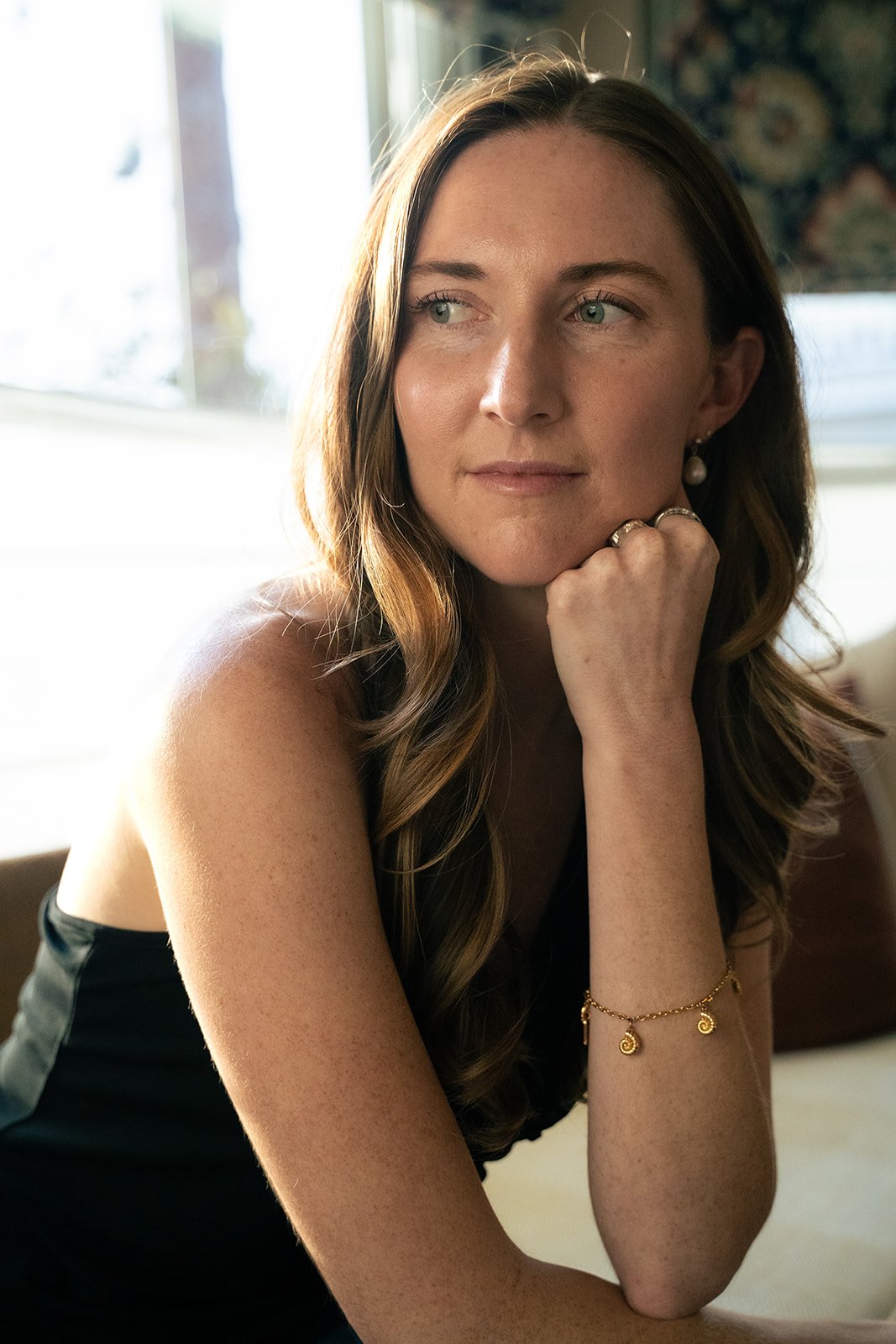
Mikaela: What is the relationship between these two sister books, A Ghost in the Throat [Doireann’s previous book, a memoir], and Said the Dead?
Doireann: I love that question so much. ‘Sister books’ is the perfect way to describe them. I've never thought of it like that before. Thank you, I'm going to carry that with me. Because I think for us as writers, as our body of work is unfolding, we're just learning ourselves in real time what it is that we're trying to do. And for quite some time, I felt that A Ghost in the Throat and Said the Dead were separate, entirely separate. But now that I've finished writing Said the Dead, I can see all the ground that they share, in terms of listening for the voices from the past, the erasure of women from the historical records and the ways in which we can still seek their presences despite their absence in those records.
Mikaela: What did you find perplexing as you wrote Said the Dead? What question remained unanswered?
Doireann: ‘Are ghosts real?’ I didn't resolve it, and I feel that that's one of the questions that's following me through my life, because I'm so interested in the past and in making a study of the past. It feels so close to me, it feels so real. I was making a study of the lives of many, many patients who were living within the asylum at different points in their lives and making a particular study of one of their doctors, Dr. Lucia. And trying to step closer and closer and closer to the reality of that past. And yet, the closer we approach our understanding of a past, the more it becomes clear that we're imagining a great deal of it.
We may feel that we are basing our understanding of that past entirely on fact. And yet, there comes a point where the human imagination steps in and starts to fill in the gaps, starts to imagine the particular echo of one particular person's footsteps on the stairwell. The particular smell that you might get as you open a door and walk into a room. I keep asking myself, “do ghosts exist?” through different books. And trying to come up with different answers to that question. The investigation is always interesting. And always inconclusive.
Mikaela: Maybe that's what ghosts would prefer. They don't want you to know.
Doireann: Maybe they’re trying to protect their own privacy.
Mikaela: One line that struck me was “She’d never been alone in this, not once. She’d always been plural.” Tell me more about the different voices that guided this story. How did you distinguish their POVs?
Doireann: It felt very much to me from the beginning as though all these voices were like a choir. And as much as I wanted to carry all the voices I was studying with me from the archive and include them in this book, there were certain voices that would stand out, like soloists. It was difficult to choose those on whom the light of the book would fall most clearly. That was a wrench. In earlier drafts of the book, I kept writing way too long, because I wanted to take everyone with me. In every draft, when I would hit about 110,000 words, I felt I was nowhere near the end of the book. It was exasperating because I knew I hadn't created anything close to a book that I could honor readers with.There was a process of distillation that I really, really struggled with because I'm soft, and I didn't want to place anyone to one side.
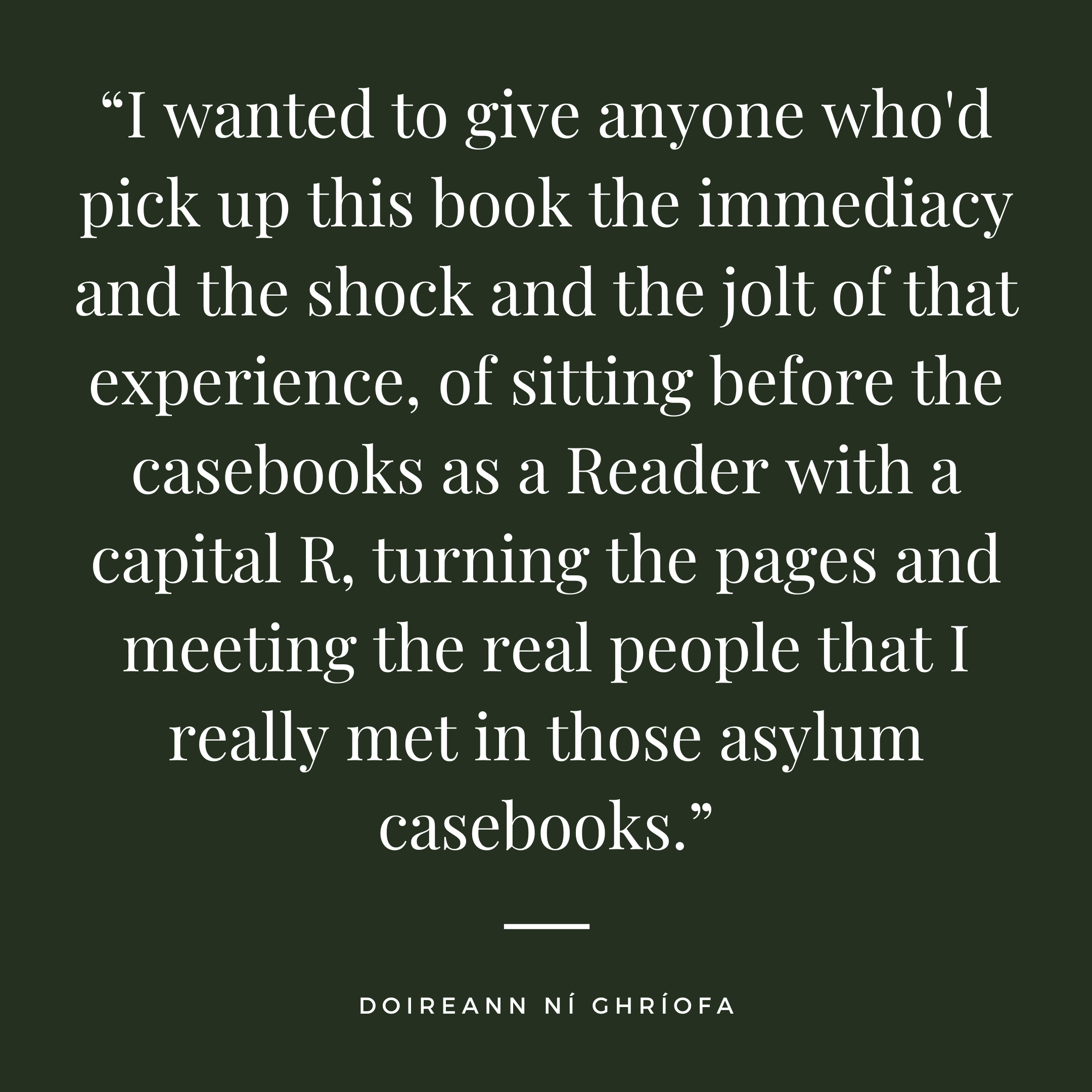
Then, in terms of point of view, when I was doing the research for this book, when I was entering the archive, you register as a Reader with a capital R. And you enter the Reader's room, and you sit down, and you read and read, and it was through the process of reading that I found myself coming closer and closer to the asylum that was alive on the other side of the pages of the casebooks. I was entirely transported as a reader. When I started to write this book, I wanted to give anyone who'd pick up this book the immediacy and the shock and the jolt of that experience, of sitting before the casebooks as a Reader with a capital R, turning the pages and meeting the real people that I really met in those asylum casebooks. I wrote it with the Reader at its heart, rather than in first-person singular. I loved that process. It took me by surprise. I'm used to writing in first person singular and choosing to write this character of the Reader was extraordinary, because it made me feel even closer to the strangers who will lift up Said the Dead and open its pages and make their way through it, because when a stranger picks up this book and opens it, they become the Reader. It's the purity of the act of reading. It does transport us.
Mikaela: You mix media in Said the Dead. You have prose and poetry. You have photographs, you have historical documents. Tell me about the process of curating all that ephemera.
Doireann: It was important to include original documents as much as I could to give the reader the sense that they were exploring these documents and turning the pages and having that addictive thrill of discovery that we sometimes have in archives where something unexpected jolts us. I love including visual media. I just feel that there is something very special about it, when the reader’s eye has been so used to turning the pages and encountering text. To suddenly turn the page and encounter a grainy black and white photo, and to invite the eye into that, and to perform a different kind of imaginative trick on it—there's just something so exciting about that for me. I feel like it brings the history to life in a different way.
Mikaela: You must have had so many different documents and material floating around. How did you organize it all? Or did you?
Doireann: A very good question, Mikaela. I have to laugh, because my research document is just hundreds of thousands of words long. It's ridiculous. It is the biggest document I have ever created in my life, and it has so much detail, and so many lives. Many, many, many people whose lives appear for half a sentence in this book. In my research document, I'd have 10 pages of not just their life, but their parents' lives and their children's lives. I'm not a historian but attempting to research the history of a building like this asylum was also an attempt to write the history of my city, Cork, a century ago. It was also an effort to write a history of my country, Ireland. And that is wildly ambitious. Particularly for someone who isn't a historian and who only exclusively writes weird books. But I learned so much from it and someday that huge research document might be in my literary archive, and people who visit will shake their heads and just go, what was she thinking? It's like the shadow book of Said the Dead. It was an extraordinary privilege to make myself a student of this period of history in my city.
Mikaela: You alternate between two different timelines, past and present, and then over the book they started to converge. How did you balance those two different modes of time?
Doireann: It’s interesting that you felt that slippage as the book went on. Past and present feel very blurred to me. The ever-unfolding present feels kind of like an illusion. It's so brief, it comes, it goes, it's gone. The beginning of our conversation is already in the past. And the long ago past feels just as close to me. It feels as though it's right there. I don't think I experienced the past with the distance that other people do. When things are difficult in my life, I almost disappear into the past. It’s a more comfortable place for me to inhabit. For example, when I was writing Said the Dead, I was really suffering with grief. And disappearing into this intense study of this very particular past of a single asylum in an Irish city, it felt like a relief to step backwards from my own extremely painful life and to make myself an invisibility in this ever-unfolding past. Being in the archive, I was reading about extremely specific griefs and losses that the women there had suffered. I felt such kinship and such closeness to them. That was a great balm to me. I never really feel alone because I always have that sense of the past that's right there at my fingertips and the people who are inhabiting it. And I always have the sense of my readers there with me as well, urging me on and urging me to be brave. It's a strange way of being, but this is my life, and I wouldn't change it.
Mikaela: Wow, that’s beautiful.
Doireann: We can't underestimate the cognitive effects of grief. Both of my books, A Ghost in the Throat and Said the Dead, are very concerned with how we as women experience and attempt to articulate or fail to articulate grief.
Mikaela: I hadn't made that connection and it makes so much sense. Whether you're writing poetry or prose, you’re a poet at heart. How did the book's lyrical style bear on its themes? Non-human entities are given human verbs like “the starlings gossiped”, or “the sunlight strode.” You plop us into a very enchanted world through your language.
Doireann: Language is so precious to me. I suspect that that's why it takes me so long to write my books, because I read them out loud to myself over and over and over again, making tiny adjustments to the language with each read-through. Tiny but important, I would say, in my defense. And it's almost as though I'm listening for the air of the song. There’s a certain melody through every sentence. It’s my ear that does the work. That takes a lot of time.
Genre is always a problem for me. I really struggle when people want to know whether to shelve it as fiction or nonfiction. I feel like they're all really long prose poems. They should all be in poetry. I'm someone who's in love with fact. But I tend to go on intense flights of fancy so I feel so uncomfortable whenever I see any of my books in nonfiction, because I could study someone's life, I can figure out the outline and the facts. But then there comes a certain point where I will imagine them sitting in a room daydreaming, and a slant of light makes its way across their face, and it's me giving them the daydream. And that's no longer fact. That's the point where I have seeded something in their imagination on the page. That’s why I feel uncomfortable. There's always imagination at work in my books and I kind of wish that I never had to figure out which shelves they go on. They could just be books. Let's just call them books.
Mikaela: How long did it take you to write Said the Dead?
Doireann: Five and a half to six years, I'd say. And I worked on it every single day.
Mikaela: Really?
Doireann: Yeah, even Christmas Day.
Mikaela: If Dr. Lucia were to write something in her casebook about you today, what would she write?
Doireann: ‘Discharged, recovered’. I feel actually a bit weepy saying that. I think that she would have seen me as incorrigible at certain points. She would have been baffled by my obsessiveness of going to the archive every day, and reading compulsively, and some of the more dangerous risk-taking, trespassing behaviors. Ultimately, some of those difficulties were redeemed by the act of writing. I feel that she would be pleased with the fact that I finished the book and let go of it, to find its way to readers. I didn't stay locked in the archive reading the casebooks every day for the rest of my life.
Mikaela: You escaped the archive.
Doireann: Yeah, and I think that's what she would have wanted for me.
This interview has been edited and condensed for clarity.
Mikaela Ryan / Writer
Mikaela Ryan is based in Los Angeles, where she received her MFA in creative nonfiction from Antioch University. She is a member of Morning Writing Club, a contributing writer for Sunny’s Journal and Press and has published book reviews and short fiction in Terrazzo Mag, Fan Boy, Barrelhouse, and Psaltery and Lyre. She is currently working on a debut novel.
Read More