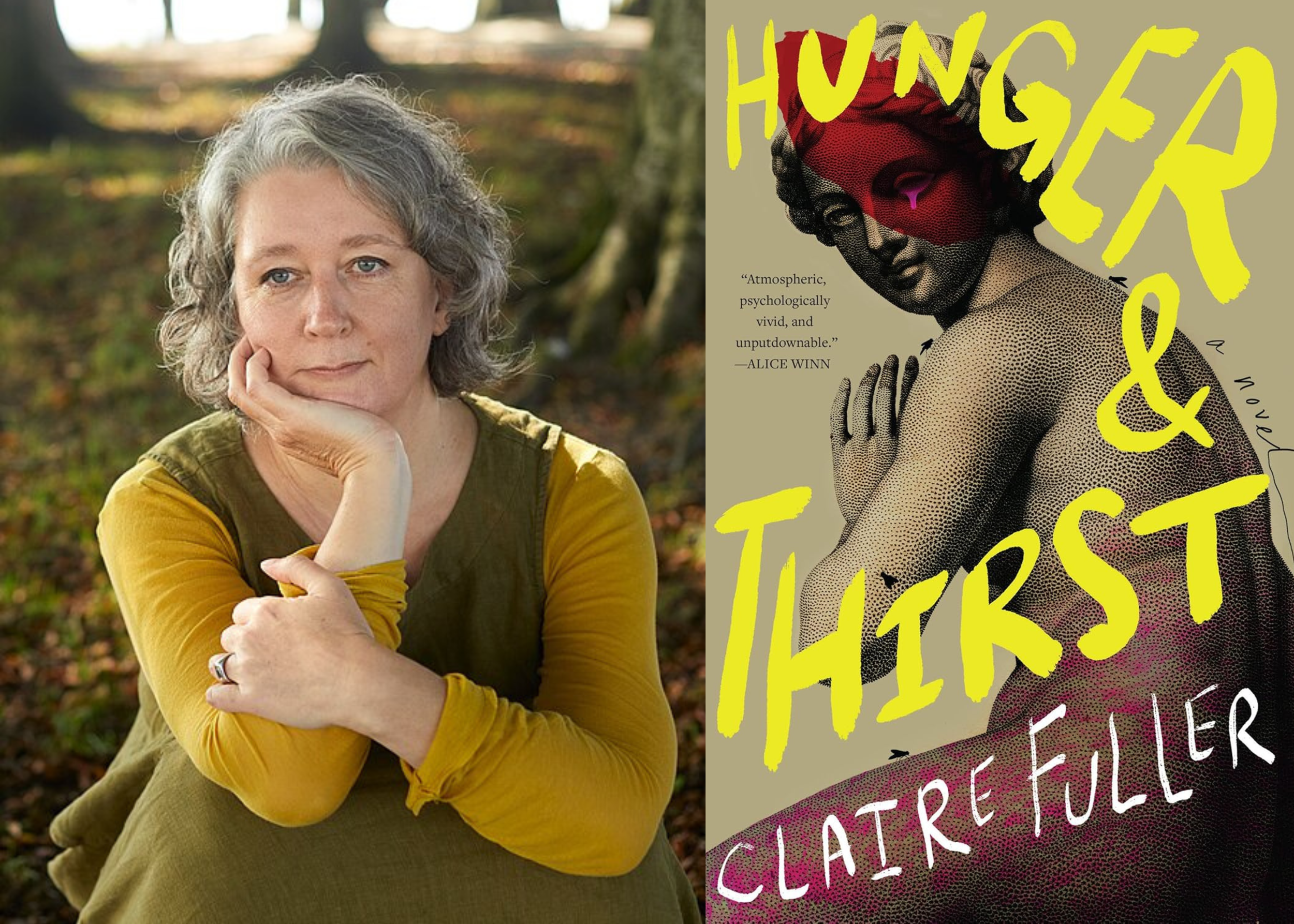
Claire Fuller on “Hunger & Thirst”, Grounding Scary Scenes, and Building Tension with Retrospective Narrators.
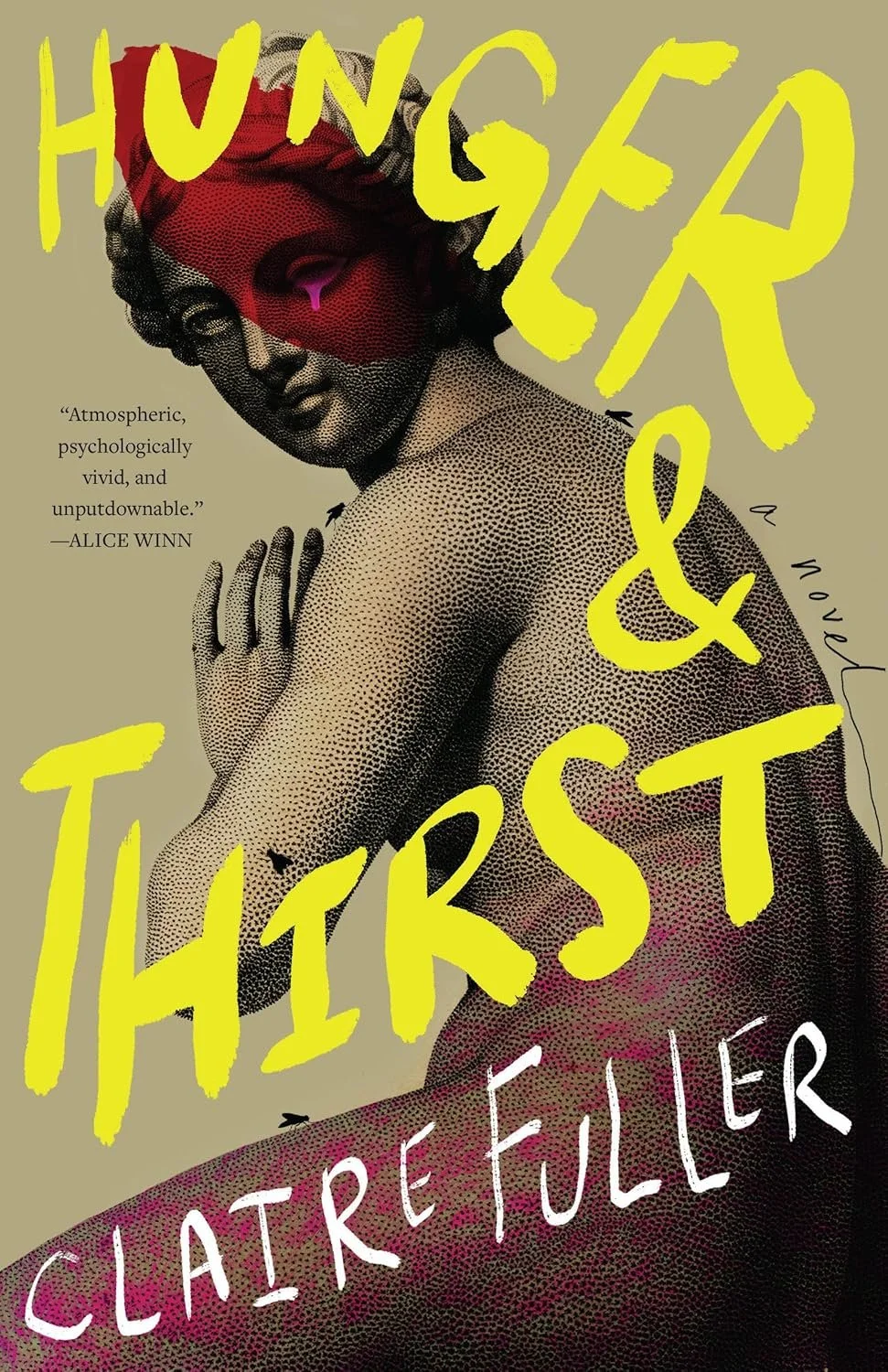
Claire Fuller’s new novel, Hunger & Thirst, is set in the ‘80s and follows Ursula, a sixteen-year-old girl in the care. She works in the mailroom at the local art college, which is where she meets Sue, a confident and self-assured aspiring filmmaker. At Sue’s suggestion, Ursula joins a squat at an abandoned bungalow called the Underwood. There, Ursula lives among the long-abandoned belongings of the previous occupants, who, she later learns, met a tragic end. Ursula gets pulled even deeper into Sue’s orbit, until Ursula carries out one of Sue’s violent dares. This act will leave her haunted for years to come.
In the present day, a true crime documentarian, Emma Zahini, is investigating a disappearance from the Underwood all those years ago. Soon, the Zahini uncovers Ursula’s identity as a reclusive sculptor working under a pseudonym. This discovery forces Ursula to face the past that she’s been trying to outrun.
At once an unsettling gothic horror tale and an affecting coming-of-age story, Hunger & Thirst draws the reader in with its meticulously rendered haunted house. What makes this book a page-turner, though, is the relationships Ursula builds with her new friends, as well as the tension from the present-day narrator still haunted by her past.
Below is my conversation with Claire Fuller. We discuss the real house that inspired the setting, her advice for writing scary scenes, and more.
Meghan: What was the inspiration for Hunger & Thirst? How did the idea first come to you?
Claire: It’s always really hard to describe the origin story for a novel, because it’s loads of little things that all coalesce. I wrote a short story about a young woman who goes to dinner with her colleagues, and her colleagues are really horrible to her – one of them in particular. He suggests that she’s been brought up by wolves or bears, and she threatens him with a knife. That was the story. That’s all that happened, but I was still interested in who those people were. [I was] interested to write more about them [and] discover who they were, why they behaved like that, what their backstory was. I thought I’d like to write a little bit more about them to discover that.
At the same time, I was thinking [that] I’ve never really written a scary story before. All my novels are dark, but none of them have gone as far as you can go. I was thinking that the [character] in the restaurant [would be] in Winchester, which is the town I went to when I was about her age and [where] I went to the art school. I was remembering my time [there] in the 1980s. I lived in a bungalow, which was a squat [and] full of someone else’s possessions. I lived there for a few months, but the young woman who had lived there before me told me this story: one night they were inside the house and someone knocked on a window and then they went to the next window and knocked on that window and the next one. And they were running around the house. These girls were inside. It’s the 1980s – no mobiles, not even a landline. They were really scared, and nothing else happened. That’s always stuck in my head, even though it didn’t actually happen to me. This house was really weird. It was a very odd place to live among someone else’s belongings. The man had gone off to Australia, decided never to come back, and, so, we lived in his house with all his stuff.
Meghan: That leads perfectly into my next question which is [about] the setting of the Underwood and how essential it is to the story. What stood out to me is there’s a really delicate balance between making the setting feel very real and also very haunted. What is your approach to writing a setting like that? How do you balance making the reader feel grounded while still playing on the uncertainty, doubt, fear?
Claire: It’s a fine line to balance. I really wanted it to feel like a real place, however weird it was. I wanted the unsettling feeling to creep up on the reader in the way that it creeps up on Ursula. You know, she is very excited to go to this place at first, because she thinks she will have her own home for the first time. Very soon she begins to realize that it’s not everything that she’s imagining. I don’t know that I thought consciously, ‘Oh, I want to make this a haunted house. How do I do that?’ It’s just [that] I wrote into the story and drew on a lot of my memories of the real place. The layout is nearly the same. Lots of things that are in the book are the things that were there. The bathroom was like that. The kitchen was like that. There were slugs in the kitchen. It was not a very nice place. So, it was about remembering and remembering my feeling uncomfortable and trying to tap into that and get it on the page. Then I took it one step further, or two steps further, or ten steps further, just playing on the idea of what it would be like to be amongst someone else’s belongings if you’re a character like Ursula who is, at the beginning, afraid of doing things wrong, upsetting people. It’s important to her that she puts things back where she finds them.
Meghan: How do you decide what to withhold from the reader and when – or if – to reveal things? Is the placement of the reveal something you discover as you’re writing? Or do you find it in the revision process?
Claire: A bit of both. There’s a lot of revision. I edit as I go along, but then, there might be a year of revision after I’ve finished what is technically the first draft. I really wanted something big at that midpoint, which I’ve never particularly thought about in any of my other novels. I do know that the beginning of this novel is quite slow, deliberately slow. Things are being drip-fed to the reader, so I wanted something big in the midpoint. That reveal and then what happens afterwards, I wanted that as close to the middle as I could get.
Because, the very first paragraph [says] that there has been a murder and Ursula is involved. – she talks about where they put the body, she doesn’t name who has been killed. It was very important to keep that information back, to try to get the reader to consider that it could be all sorts of people. There’s a point when the social worker, Joy, comes around and Sue goes, ‘Should we kill her?’ I’m hoping the reader might think, ‘Well, maybe it’s Joy’ or ‘Maybe it’s Vince, because of the terrible things he does.’ It could be any one of them. When I was inserting the sections from the true crime documentary, where they were placed and how much information they reveal was really crucial. Every time I had one of those scenes, it would reveal that [a certain character] is not the dead person.
Meghan: A lot of the tension came from the distance between the present-day narrator and her sixteen year old self. Why was having the retrospective narrator so important to you? Why did the documentary film feel essential to the plot?
Claire: I didn’t want to write just in the present-day of 1987 with Ursula being 16, because I wanted her to be able to reflect a little bit on what had happened and be affected by it in her later life. Also, I knew I didn’t want to write a YA novel. If you’re writing about a sixteen year old who hasn’t had much education, is very naive, then the kind of language she uses is going to be much more juvenile than I wanted to write in. At some point, I was thinking, ‘But why now? Why is she looking back now? What has happened that is making her look at that period, remember it?’ At one point, I had her write it down as a response. I considered all sorts of things. I could have had a journalist doing some kind of investigative inquiry or, at one point, I thought it could be the police. But then, the police would have had to turn something up, so they would have had to find a body, or find some new evidence. So, that didn’t work either. The true crime documentary came out of that necessity. Then it worked so well when Sue wanted to be a film director. She makes films. They watch films. The fact that a film is being made seemed to make sense.
Meghan: I’m always drawn to books that center friendship, especially female friendship, as the primary relationship. That dynamic was immediately recognizable to me as someone who was once a sixteen year old girl. Why did you want to center female friendship and all of the complexities that come with it?
Claire: That was not a plan. I don’t start with a plan when I’m writing. I just start with a person and a place. I didn’t know that Sue was going to be a very big character. She just appears on the page. She’s at that dinner [with colleagues], and then, as I wrote on, she then comes around to the [halfway] house and that’s how they meet properly. She’s the one who convinces Vince to invite [Ursula] to the bungalow. She just grew on the page. Ursula had to start by being this fairly timid person, unsure of herself and how she fits with people, whereas Sue was just this big character from the very beginning. [She was] very self-confident. [She] knew what she wanted and was going to get it. I share my writing with a couple of writing groups. They were saying, ‘More Sue, More Sue!’ It was not something that I planned. Of course, I drew on my sixteen year old self and relationships with other girls, what worked and what didn’t. By that time, I think, those characters just became very real. I know it’s ridiculous for a writer to say, ‘Oh, the characters took over,’ but scenes arrived that I hadn’t planned that just worked with their dynamic. I find that interesting as a writer. I write to discover what happens.
Meghan: I’m curious about the role of creativity and creation. Ursula uses sculpting as a coping mechanism, a means of avoidance, a means of isolation. Can you talk about the process of writing art and writing creativity?
Claire: In some of my other novels, I have musicians. So, I had to write about their music, about music creation, and that is so much harder than writing art, [which is] physical. In a way, writing sculpture was a joy, because it’s much easier than writing music in a novel. Plus, I’ve been a sculptor. That’s what I did for many years, though mostly stone carving, a bit of wood carving. It was fun. That was the bit that I really enjoyed. To have Ursula make some art that I didn’t actually have to make. Wood carving is hard work, and it often goes wrong. Bits of the wood fall off, or you get right into the middle of the piece of wood and it’s rotten. [It’s] very similar to writing. Sometimes, you write yourself into a corner, it doesn’t work, and you have to backtrack. Or, you write something, and you think ‘Oh, yes, that’s what I really want to do,’ and then you have to go back and change everything else. Sculpting is very similar. Writing the bear carving, where the eyes are human eyes and the teeth are human teeth, and she won prizes for it. It was like, ‘Oh, I can be a famous reclusive sculptor without having to do any of the work.’
Meghan: What books, media, other art were references for you as you were writing?
Claire: There’s the films that [the characters] watch, that I watched over and over and over again – Rosemary’s Baby, The Stepford Wives, The Shining. I wanted to write about the horror films that I grew up with. There are lots of easter eggs in the novel for people who know those films really well. I don’t know that I read any horror novels particularly. I don’t stop reading when I’m writing, but I don’t necessarily go out and read the particular genre that I’m writing. But there’s lots of horror novels that I, perhaps, drew on without it being intentional. I didn’t really look at art either. I wanted to just be able to describe the art Ursula was making without being influenced.
Meghan: Do you have any advice for writers who want to write horror?
Claire: I hope [in this novel] the scary scenes are scary for some people, or unsettling. I’m not trying to write horror that is gory or [any] body horror. I don’t want to disgust; I want to unsettle. I think, for me, the way it worked was to write those particular scenes as if they were any scenes. You don’t heighten the language. You don’t use more metaphors. You don’t overblow it. You just write it very matter-of-factly, or in the same style as the rest of the novel. I think it works the same way if you’re writing a sex scene. It needs to be the same kind of writing as the rest of the novel, so that it doesn’t sound too flowery. Then, I think it’s going to be more frightening. If you keep it the same as the rest. It’s more likely to creep up on the reader, when they’re not necessarily expecting it.
This interview has been edited and condensed for clarity.
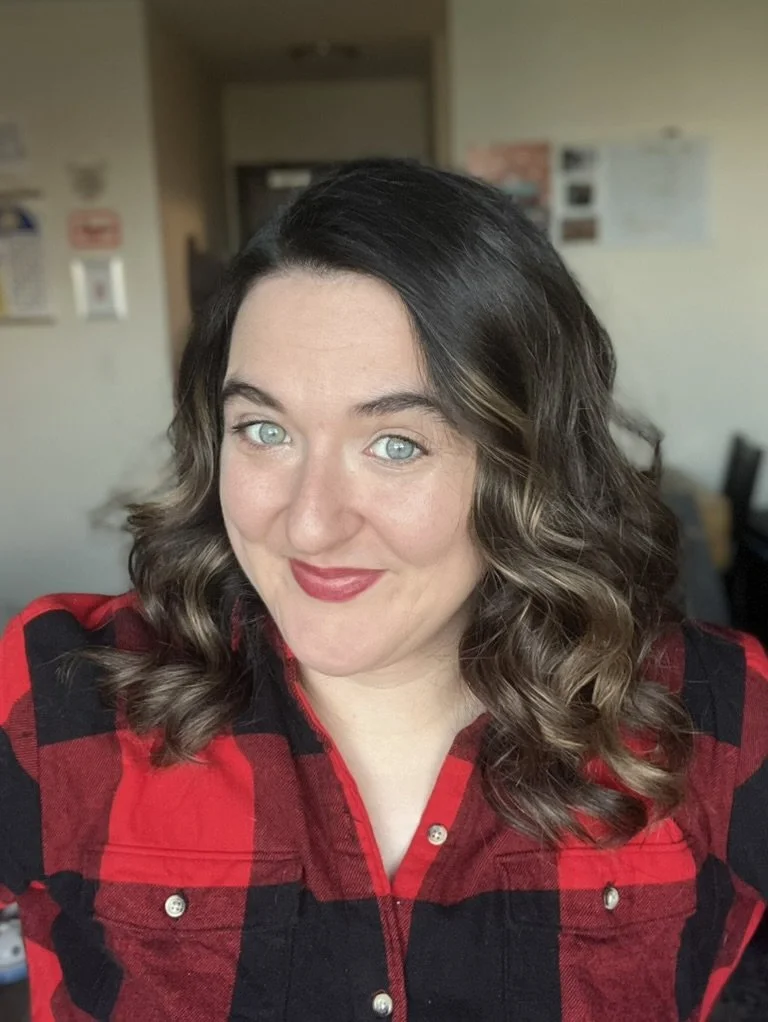
Meghan McGuire
Meghan McGuire (she/her) is a writer and recovering buzzkill. She holds an MFA in Creative Writing from Antioch University – Los Angeles. Her writing has been featured in Porter House Review, Chicago Review of Books, Lunch Ticket Friday Lunch Blog, and the Fan Boy zine. Her television pilots have been recognized by Stowe Story Labs, Slamdance Screenwriting Competition, PAGE International Screenwriting Awards, and Austin Film Festival Script Competition. Born in Alaska and raised in Maine, Meghan followed her passion for cold places to Chicago where she lives with her cat, Pippin. She is working on a memoir. You can find her online at meghanmcg.com or @meghanmcwriter on Instagram.
Read More